

Hiring the right virtual assistant (VA) can save you time, cut costs, and boost productivity. This guide simplifies the process into 12 actionable steps:
- Define Your Needs: Identify tasks to delegate, set priorities, and create clear performance standards.
- Understand Filipino VAs: Learn about their work culture, pay rates (starting at $400/month), and strengths in remote roles.
- Write a Job Description: Be specific about skills, tools, and work hours to attract the right candidates.
- Use Pre-Screened Talent: Leverage platforms like Offshore Talent Board to access pre-vetted candidates and save time.
- Conduct Interviews: Ask situational questions to assess problem-solving, adaptability, and communication skills.
- Test Skills: Assign sample tasks to evaluate their expertise and familiarity with required tools.
- Check References: Verify past performance by speaking with previous employers and reviewing metrics.
- Set Pay: Offer competitive rates (e.g., $3–$15/hour) and consider additional benefits like paid time off or internet subsidies.
- Onboard Effectively: Provide access to tools, clear documentation, and training to ensure a smooth start.
- Track Performance: Use tools like Hubstaff or Time Doctor to monitor productivity and set measurable goals.
- Build Relationships: Support professional growth through training and regular feedback.
- Update Agreements: Periodically review contracts and expectations to align with evolving needs.
Why It Matters
- Save Time: Delegating tasks can free up hours each week.
- Cut Costs: Filipino VAs cost up to 70% less than local hires.
- Boost Revenue: Businesses that delegate effectively see 33% higher revenue.
Ready to hire? Platforms like Offshore Talent Board simplify the process with pre-vetted candidates and a 6-Month Right Match Promise. Start today and find a VA who can elevate your business.
21 Things To Do When Hiring a Virtual Assistant
Step 1: Define Your Business Requirements
Before starting your search for a virtual assistant (VA), it’s crucial to clearly outline your needs. Think of it as creating a roadmap - not just for hiring but for guiding your VA’s performance once they’re on board.
Studies show that constant email interruptions and excessive meetings can waste hours of your day. By pinpointing these time-draining tasks, you can delegate more effectively.
List Core Tasks and Duties
Spend a week tracking your daily activities. This simple exercise can uncover patterns and highlight tasks that eat up your time unnecessarily.
Virtual assistants can handle a wide range of responsibilities, from routine administrative tasks to more specialized roles like marketing, data analysis, or customer service. Some of the most common tasks include:
- Managing emails and calendars
- Scheduling appointments
- Data entry
- Social media management
- Content writing
- Research
- Bookkeeping
Take Nick Gray’s example from June 2024 - he leveraged VAs to handle daily sales reports, sort LinkedIn connection requests, and organize his email inbox. His assistants also scheduled meetings, processed returns from Amazon, and transcribed voice memos.
Once you’ve identified your tasks, rank them by priority. Ask yourself: Which tasks directly impact revenue? Which require your personal expertise? And which can be delegated? Keep in mind that VA rates vary significantly - from as low as $1 per hour to over $100, with an average of around $15 per hour. Rates depend on the VA’s location, skill set, and the complexity of the tasks.
If you’re unsure where to start, consider hiring a general VA first, then expand to specialists as needed.
After pinpointing tasks, set clear expectations for how they should be performed.
Establish Performance Standards
Clear expectations are the backbone of a successful working relationship. They foster accountability and help everyone stay on track.
"Setting expectations is key to achieving optimal team performance" – Forbes.
Define SMART goals for your VA - goals that are Specific, Measurable, Achievable, Relevant, and Time-bound. For example, instead of vaguely asking your VA to "handle emails", set a concrete target like: “Respond to all non-urgent emails within 4 hours during business hours and flag urgent messages within 30 minutes.”
To measure performance objectively, create Key Performance Indicators (KPIs). These could include metrics like productivity levels, quality of work, meeting deadlines, or customer satisfaction.
Interestingly, research shows that remote workers are 30% to 45% more productive than their on-site counterparts. By setting clear standards, you ensure that your VA focuses on tasks that align with your strategic goals.
Finally, streamline the delegation process by providing guidelines and templates for recurring tasks. Clear instructions not only save time but also reduce misunderstandings, laying the groundwork for a smooth and productive partnership.
Step 2: Learn About Filipino Remote Workers
Hiring Filipino remote workers starts with understanding their strengths and work culture. The Philippines has established itself as a global leader in virtual assistance, with Filipino workers making up about 13% of the world’s virtual assistant workforce. Known for their excellent English skills, strong work ethic, and alignment with Western business practices, they’re a top choice for remote roles.
The numbers back this up: 84% of Filipinos express a preference for remote international work. Additionally, the Business Process Outsourcing (BPO) industry in the Philippines is on track to generate $59 billion in revenue by 2028, employing 2.5 million people. This combination of skill, cost-effectiveness, and willingness to work remotely makes Filipino workers an attractive option for businesses worldwide.
Review Typical Pay Rates
One of the biggest advantages of hiring Filipino virtual assistants (VAs) is the cost savings. Filipino VAs provide high-quality work at rates significantly lower than their U.S. counterparts. Businesses can save up to 70%, with some roles offering as much as an 80% reduction in costs compared to Western hires.
Here’s an overview of typical pay rates based on experience and specialization:
| Experience Level | Description | Monthly Salary (USD) |
|---|---|---|
| Entry-Level | 0–1 year of experience, basic admin tasks, task-focused roles | $400–$600 |
| Mid-Level | 1–3 years of experience, process-driven, minimal supervision | $600–$900 |
| Senior-Level | 3+ years of experience, specialized skills, client-facing roles | $900–$1,600+ |
For specific job types, pay varies based on complexity and expertise. For example:
- General administrative tasks like email management or data entry: $3–$5 per hour (around $500–$700 monthly).
- Specialized technical support: $10–$15 per hour (approximately $1,300–$2,000+ monthly).
- Bookkeeping and financial management: $720–$1,600 per month.
- Social media management (including handling multiple platforms): $800–$1,200 per month for experienced VAs.
Over 90% of business owners report improved productivity and lower costs by incorporating VAs into their teams.
Understand Work Practices and Communication
Filipino work culture is a blend of collaboration, respect, and adaptability, making it ideal for remote teamwork. Two key cultural values stand out: pakikisama (the importance of group harmony) and bayanihan (a collective spirit of working together toward shared goals). These values often translate into strong relationships with clients, with many Filipino VAs treating their clients like family and showing genuine care for their success.
When it comes to communication, Filipinos are generally indirect and respectful. They often use honorifics when addressing superiors and prefer feedback to be delivered in a constructive and private manner. Requests framed as questions (rather than commands) tend to be better received. Clear instructions and regular feedback help eliminate misunderstandings and create a productive working relationship.
Filipino professionals are also accustomed to working across time zones, often adapting their schedules to align with clients in different regions. However, it’s worth noting that the Philippines observes around 18 holidays each year, compared to the U.S., which typically observes about 8. Planning around these holidays and cultural traditions is essential for smooth operations.
Key priorities for Filipino workers include job security, camaraderie, and maintaining a healthy work-life balance. To get the best results, focus on open communication. Ask specific questions, encourage feedback, and give team members opportunities to share their ideas. This approach not only fosters collaboration but also leverages their cultural strengths, ensuring a harmonious and effective working relationship with colleagues from diverse backgrounds.
Step 3: Write a Clear Job Description
Now that you’ve defined your requirements and gained insight into Filipino work culture, it’s time to create a job description that stands out. A well-written job description not only attracts the right Filipino virtual assistant (VA) but also establishes clear expectations from the beginning.
Start with an engaging headline that captures attention and reflects your company’s personality. Instead of something generic like "Virtual Assistant Needed", try a more inviting option: "Join Our Team as a Virtual Assistant - Bring Your Creativity and Organizational Skills to Help Businesses Succeed!"
When listing job responsibilities, be specific. Avoid vague phrases like "manage emails." Instead, outline measurable tasks, such as "respond to emails within 24 hours using a structured filing system to organize correspondence."
Filipino workers place a high value on teamwork and a sense of belonging. Highlight your company’s values and culture in the description. For example: "We’re more than a company - we’re a community. We value collaboration, innovation, and maintaining a healthy work-life balance. Your ideas and contributions will always be appreciated here."
Laying out expectations clearly from the start can also improve retention. Research indicates that employees are 23% more likely to stay when roles and responsibilities are clearly defined.
List Required Skills and Tools
Be upfront about the skills and qualifications you’re looking for. Include essential requirements like strong communication abilities, relevant experience, and technical know-how. Clearly distinguish between must-haves and nice-to-haves so candidates can assess their fit before applying.
Mention any tools or software your VA will need to use. For example, a reliable internet connection and platforms like Zoom for video calls may be essential. If the role involves specific technical skills, specify them - such as experience with accounting tools like QuickBooks or Xero, project management software like Asana or Monday.com, or social media tools for scheduling content.
For administrative tasks, list the required proficiency in tools like Google Workspace or Microsoft Office, CRM platforms like HubSpot or Salesforce, and communication apps like Slack or Microsoft Teams.
Specify Work Hours and Deliverables
Be clear about the required work hours and time zone to avoid confusion. This is especially important when coordinating across different regions.
Define deliverables with measurable outcomes. Instead of saying "manage social media", specify targets like "create and schedule three posts per week", or "respond to comments within 12 hours." For other tasks, like document handling or expense tracking, set clear deadlines and goals to ensure alignment.
Also, clarify how and when you’d like to communicate. Whether it’s daily check-ins, weekly progress updates, or scheduled video calls, these details help establish mutual expectations for performance and accountability.
Finally, wrap up your job description with a strong call to action. Provide clear application instructions - mention any materials you need, like a resume, portfolio, or cover letter - and outline the timeline for your hiring process. This ensures you’re ready to move forward with pre-screened candidates through Offshore Talent Board.
Step 4: Use Offshore Talent Board for Pre-Screened Candidates
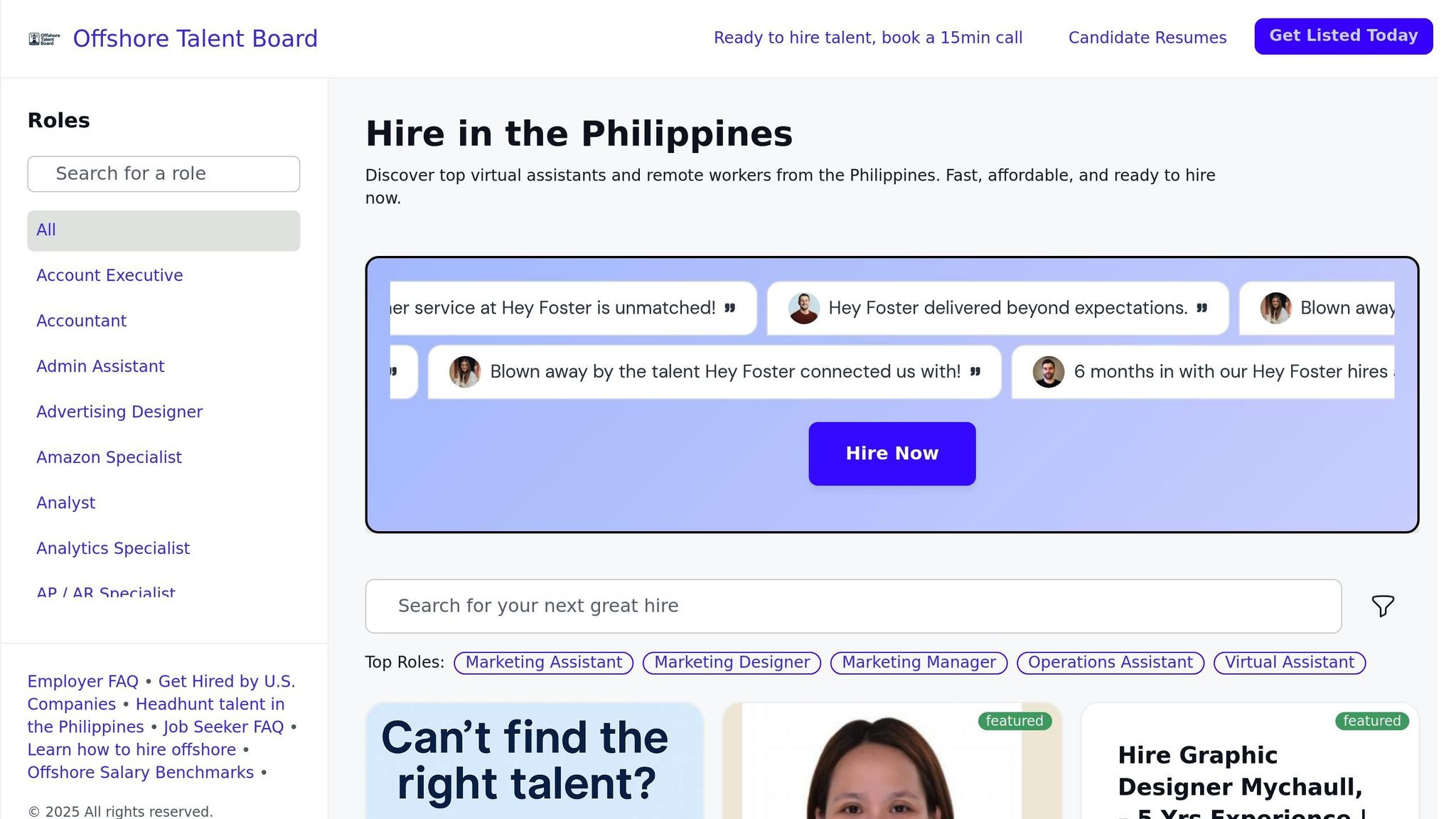
Once your job description is ready, it's time to connect with qualified candidates - without the hassle of a traditional recruitment process. Offshore Talent Board offers a direct and efficient way to access pre-vetted Filipino virtual assistants (VAs) who are ready to start immediately. This approach not only saves time but also ensures you’re hiring skilled professionals.
Why is this important? Recruitment can be expensive. According to SHRM, the average cost of hiring a new employee is nearly $4,700. By streamlining the process with Offshore Talent Board, you can cut down on these costs while maintaining quality.
The timing couldn’t be better to tap into offshore talent. A Korn Ferry study estimates a global talent shortage of over 85 million people by 2030, potentially leading to $8.5 trillion in lost revenues. As Singapore’s former Prime Minister Lee Kuan Yew wisely observed:
"If you deprive yourself of outsourcing and your competitors do not, you're putting yourself out of business".
Outsourcing doesn’t just save money - it drives growth. Research shows that hiring virtual assistants from the Philippines can reduce labor costs by up to 80%. Additionally, businesses that delegate effectively through outsourcing grow 30% faster than those that don’t.
Review Pre-Screened Profiles
Offshore Talent Board provides detailed profiles of candidates who have already passed a rigorous screening process. These profiles include key details about each VA’s skills, experience, and work history, giving you a clear picture of their qualifications.
Each profile highlights technical expertise, communication skills, and familiarity with tools like Google Workspace, Microsoft Office, and various project management platforms. You’ll also find information about their English proficiency and time zone availability, making it easier to identify the right fit for your business.
The screening process includes resume reviews, initial assessments, and background checks. This allows you to focus on candidates who meet your specific needs, saving you time and effort.
Another advantage? Filipino virtual assistants are known for their adaptability. Many are willing to adjust their schedules to accommodate employers’ needs, including working nights, weekends, or outside standard 9-to-5 hours to meet deadlines or handle urgent tasks.
Skip Job Posting Steps
Offshore Talent Board eliminates the need for traditional job postings, streamlining the hiring process even further. Instead of waiting weeks for applications, sorting through unqualified resumes, and conducting initial screenings, you can jump straight to evaluating pre-qualified candidates.
This model not only saves time but also reduces costs. By cutting out lengthy recruitment steps, you can focus on meaningful conversations with candidates who are ready to start immediately. Whether you need help with a short-term project or a long-term role, this approach offers the flexibility to hire quickly and efficiently.
For employers, accessing the Offshore Talent Board directory is free. You only pay a one-time placement fee of $4,500 when you successfully hire a candidate. This performance-based pricing aligns the platform’s success with your own.
With its established networks, advanced tools, and efficient workflows, Offshore Talent Board enables faster hiring compared to traditional in-house recruitment teams. This is especially beneficial when you need to scale your team quickly or fill urgent roles without compromising on quality.
Step 5: Run Organized Interviews
Once you've reviewed the pre-screened profiles from Offshore Talent Board, the next step is conducting structured interviews. These interviews help you dig deeper into a candidate's remote work skills, critical thinking, and ability to adapt - qualities that aren't always obvious from a resume. This process ensures you're selecting a virtual assistant who can work independently while delivering the quality and reliability your business needs.
Ask Situation-Based Questions
Using situational questions is a great way to understand how candidates have tackled challenges in the past and how they'd handle similar situations in the future. Here are some examples to guide your interviews:
- "Can you describe a challenging situation you faced as a virtual assistant and how you resolved it?"
This question highlights their problem-solving skills and ability to stay resilient under pressure. - "What would you do if you were given a task outside your expertise?"
A good way to gauge their willingness to learn and adapt to new challenges. - "How do you handle a situation where you are unable to meet a deadline?"
This explores their time management skills and sense of accountability. - "What would you do if a client was unhappy with your work?"
This helps you assess their approach to client communication and conflict resolution. - "How would you handle technological problems, such as your computer crashing or a shaky connection?"
A practical way to measure their technical readiness and problem-solving abilities. - "What do you do when a client isn't articulating their requests well?"
This reveals whether they ask clarifying questions and ensure mutual understanding.
These types of questions not only reveal the candidate's experiences but also provide insight into their thought processes and communication style.
Evaluate Communication Abilities
Strong communication skills are essential for remote roles. During video interviews, pay attention to how clearly candidates express themselves, their level of engagement, and even non-verbal cues like eye contact. You can also ask them to share examples of how they've resolved past miscommunications or explained complex ideas effectively.
To take it a step further, consider assigning a real-time task during the interview. For instance, ask them to present a brief report or brainstorm a hypothetical project. This allows you to see how they organize and communicate detailed information under pressure. Additionally, review their early email exchanges, as written communication will likely be a significant part of their role.
Lastly, introduce them to your company's remote work culture and ask how they see themselves aligning with or contributing to it. This can help you gauge whether they’d be a good fit for your team.
For the interviews, use reliable video conferencing tools like Zoom, Microsoft Teams, or Google Meet. Beforehand, test your audio and video settings, choose a quiet and well-lit space, and provide candidates with clear instructions on how to join the call and what to expect during the interview.
Step 6: Test Job-Related Skills
Testing candidates' practical skills is a crucial step in the hiring process. It helps you move beyond assessing communication and interview performance to see how well a virtual assistant (VA) can handle the actual demands of the role. This process offers a real-world glimpse of their ability to meet your business's quality and efficiency standards.
The key is to design tests that mirror the tasks your VA will encounter daily. Generic assessments won’t cut it - focus on challenges tailored to your specific business needs and environment.
Give Sample Work Tasks
Start by assigning a practical task that’s relevant to the job, challenging enough to evaluate their skills but not overwhelming. These tasks should test their problem-solving abilities, attention to detail, and how well they follow instructions.
For example, if your VA will handle email management, create an exercise where they organize a messy inbox, prioritize emails, and draft professional responses. If the role involves research, ask them to compile information on industry trends or conduct a competitor analysis within a set timeframe.
Be clear about what you expect. Provide detailed instructions, necessary resources, and realistic deadlines. This not only evaluates their time management but also their ability to seek clarification when needed - an important communication skill. Make yourself available to answer questions during the task, as this also reveals their willingness to ask for help when necessary.
Consider including tasks that require creative thinking or adaptability. For instance, give them incomplete or conflicting information and see how they handle it. This approach can highlight how they respond to real-world challenges and unexpected hurdles.
Some companies, like Orica, use comprehensive skill assessments to evaluate technical and logical abilities. When Orica incorporated skill testing into their hiring process for graduate roles, they achieved an 86% completion rate and received positive feedback from candidates.
To design effective tests, break down complex roles into specific skill sets. If your VA will handle customer service, create scenarios that involve resolving difficult client situations. For administrative support, test their ability to manage calendars, schedule meetings, and handle conflicts in scheduling.
Beyond these simulations, it’s essential to verify their technical skills.
Check Software Knowledge
A VA’s technical proficiency often determines how quickly they can start contributing without extensive training. Instead of relying on self-reported skills, observe candidates using the tools they’ll need for the job.
One effective method is to conduct screen-sharing sessions during video calls. Ask candidates to perform specific tasks using the relevant software. Watch for their speed, use of keyboard shortcuts, and overall confidence in navigating the tools.
For example, you could have candidates edit a document, create a spreadsheet, or design a simple presentation while you observe. This approach not only confirms their familiarity with the software but also shows how efficiently they can complete tasks.
For specialized tools, consider assigning mini-projects. If your business uses HubSpot, ask candidates to create contact records, set up email sequences, or generate basic reports. For social media roles, have them design posts in Canva or schedule content using Hootsuite.
"I think the questions were very diverse and it allowed me to showcase myself, my skills and abilities in different ways." – Orica Candidate
You can also use online platforms that provide software-specific tests, but don’t stop there. Supplement these with live demonstrations to get a better sense of how candidates apply their knowledge and solve problems in real time.
Finally, test their ability to adapt to unfamiliar software. Provide basic instructions for a new tool and see how quickly they learn to use it. This adaptability is invaluable, especially since businesses often adopt new technologies, and VAs must keep up with these changes.
sbb-itb-6310442
Step 7: Check References and Work History
Verifying references is a critical step in understanding a candidate beyond their interview performance. According to the Society for Human Resource Management, reference checks can uncover 36% of potential discrepancies, helping you avoid hiring mistakes that might disrupt your operations. This step is particularly important when hiring virtual assistants, as you're entrusting responsibilities to someone you may never meet face-to-face. By conducting thorough reference checks, you can confirm the skills and work habits discussed during interviews and assessments.
This process offers a window into the candidate's real-world performance - how they handle tasks, interact with others, and approach challenges - through honest feedback from those who’ve worked with them directly.
Call Former Employers
Start by contacting the candidate's previous employers. For international references, video calls can add a personal touch, but remember to account for time zone differences. Be mindful of communication styles, especially when speaking with Filipino employers, as they may use more indirect language. Pay attention to subtle cues that might reveal insights about the candidate’s performance.
When speaking with references, confirm their relationship with the candidate: their role, the duration of their working relationship, and the responsibilities the candidate held under their supervision. Use a structured list of questions to go beyond basic verification and gather meaningful feedback.
Here are some key areas to explore during these calls:
Performance and Skills:
- What were the candidate's most notable accomplishments during their time with you?
- How effectively did they handle the core responsibilities of their role?
- Can you share examples of their problem-solving skills?
Work Habits and Reliability:
- How well did they manage deadlines and perform under pressure?
- Were they dependable in terms of attendance and meeting commitments?
- How would you describe their attention to detail?
- How did they respond to feedback and incorporate it into their work?
Communication and Teamwork:
- How strong were their communication skills, both written and verbal?
- How did they collaborate with team members and interact with colleagues?
- Can you provide examples of their ability to work within a team?
The Big Question:
- If you had the chance, would you hire this candidate again? Why or why not?
Take note of any hesitations or vague answers - these could signal potential concerns about the candidate's performance or reliability.
Ask for Performance Data
In addition to qualitative feedback, quantitative data can provide objective proof of a candidate's abilities. Ask for specific metrics or examples that demonstrate their impact in previous roles. For instance, inquire about task completion rates, accuracy levels, or the volume of work they handled.
Consider asking these performance-related questions:
- What was their typical workload, and can you share examples of projects where they exceeded expectations?
- How did their performance compare to others in similar roles?
- Did they earn any promotions or recognition during their time with you?
- On a scale of 1 to 10, how would you rate their performance compared to others you've worked with?
Don’t just focus on their successes - ask about areas where they could improve and how they responded to constructive criticism. This can give you a better sense of their ability to grow and adapt professionally.
"Reference checks aren't simply a 'gotcha' exercise to catch candidates in a fib or exaggeration. They're a chance to better understand the qualities and skills Pat brings..." - Bruce M. Anderson, Content Marketer / Editor / Writer
Whenever possible, request supporting documentation like performance reviews, project outcomes, or work samples to validate the feedback you’ve received.
Take detailed notes during your calls and compare feedback from multiple references to identify consistent patterns - whether positive or negative. Before wrapping up, ask each reference if there’s anyone else they recommend speaking with to gain a more complete picture of the candidate’s work history and abilities.
Step 8: Set Pay and Benefits
Offering competitive pay is essential to attract skilled virtual assistants (VAs) while keeping your expenses in check. Filipino VAs are a cost-effective choice, with salaries averaging about 70% lower than hiring locally. This allows businesses to save significantly without compromising on quality. Striking the right balance between competitive compensation and your budget is key.
Understand Market Rates
To set appropriate pay, it’s important to know the going rates. Entry-level VAs typically earn between $400 and $600 per month, while those with niche skills or more experience can command up to $1,200 monthly. Additionally, 80% of businesses hiring Filipino VAs report increased productivity, with overall savings reaching as high as 70% compared to hiring locally.
Hourly rates for Filipino VAs generally range from $3 to $15, depending on the role and expertise required. Use this as a baseline and adjust based on the complexity of the tasks and the level of experience you’re looking for.
Here’s a breakdown of typical pay rates across different roles:
| Role Category | Experience Level | Hourly Rate (USD) | Monthly Estimate |
|---|---|---|---|
| General Admin | Entry | $3 – $5 | $500 – $700 |
| Customer Support | Entry–Mid | $4 – $6 | $600 – $900 |
| Executive Support | Mid–Senior | $6 – $8 | $800 – $1,100 |
| Social Media Management | Entry–Mid | $4 – $7 | $650 – $950 |
| Content Marketing | Mid | $6 – $9 | $800 – $1,200 |
| Graphic Design | Mid–Senior | $7 – $12 | $1,000 – $1,500 |
| Bookkeeping | Senior | $8 – $12 | $1,100 – $1,600 |
| Tech Support/IT | Senior | $10 – $15 | $1,300 – $2,000+ |
If you're unsure about the right rate, consider starting with a slightly lower pay during a probationary period. Once the VA meets performance expectations, you can increase their rate. Negotiation is part of the process, so be clear about your budget but flexible enough to account for the candidate’s skills and experience.
Offer Additional Benefits
Compensation isn’t just about salary; extra benefits can make your offer more appealing without significantly increasing costs. A 2023 survey revealed that 70% of Filipino VAs prioritize work-life balance and opportunities for career growth. This highlights the value of non-monetary perks in their decision-making.
Here are some benefits to consider:
- Government-mandated benefits or assistance with insurance/HMO.
- Paid time off for national holidays.
- Internet subsidies and performance-based incentives (even a modest $1–$2 per hour raise is appreciated).
- Professional development opportunities, such as training or access to learning resources.
These perks not only respect local customs but also contribute to long-term productivity and loyalty.
Payment Terms and Methods
Ensure clarity in payment terms. Use reliable channels like PayPal or Wise, and cover any transaction fees so your VA receives the full amount. Paying in Philippine Pesos (PHP) can also protect them from unfavorable exchange rates.
Establish a payment schedule - weekly, bi-weekly, or monthly - depending on what works best for both parties. Many VAs, especially when starting a new role, prefer frequent payments as it offers financial stability and helps build trust.
Step 9: Set Up New Hire Training
A well-organized onboarding process is key to setting up your virtual assistant (VA) for long-term success. Research from Stanford highlights that businesses effectively using remote work tools can save up to $11,000 annually for each part-time remote worker. By equipping your VA with the right tools and clear guidance, along with consistent weekly check-ins, you can ensure a smooth start.
Give Access to Work Tools
Make sure your VA has access to all essential software before their first day.
Your setup should include tools across five main categories: task management, communication, file sharing, time tracking, and security. Here’s what to consider for each:
- Communication tools: Platforms like Slack for messaging, Zoom or Google Meet for video calls, and a company email account ensure seamless team collaboration. Assign access levels carefully to give your VA only the permissions they need for their role.
- Project management platforms: Use tools like Asana, Trello, or Basecamp to track tasks and deadlines. Provide clear instructions on your team’s workflows and how to use these platforms effectively.
- File sharing systems: Centralize important documents with systems like Google Drive or Dropbox. Set up backup and security measures to protect sensitive information.
- Time tracking software: Tools like Toggl, Time Doctor, or Harvest help monitor productivity and manage billing, especially for hourly roles.
- Security tools: Password managers such as LastPass, 1Password, or Dashlane safeguard company accounts and sensitive data.
For specialized tasks, consider additional tools - QuickBooks for bookkeeping, Calendly for scheduling, or Hootsuite for social media management might be helpful. Creating short tutorial videos for each platform gives your VA a handy reference they can revisit as needed.
Once the tools are in place, focus on documenting your processes to create a consistent workflow.
Create Process Documentation
Clear documentation is the backbone of successful remote work.
Start by developing Standard Operating Procedures (SOPs) for recurring tasks. As Pradeepa Somasundaram, Senior Product Marketing Manager at Document360, puts it:
"Process documentation is a step-by-step instruction on how to complete a process from beginning to end".
Each SOP should define the purpose of the task, its scope, and include detailed, step-by-step instructions. Be sure to specify roles, key definitions, and any necessary references.
When writing these documents, clearly outline the process being documented, its start and end points, and the completion criteria. Use straightforward language, short paragraphs, and bullet points to make the content easy to follow. Visual aids like screenshots, flowcharts, or diagrams can further enhance clarity.
Store all documentation in a central knowledge base. Tools like Notion, Confluence, or a well-structured Google Drive folder are excellent options. Set up communication guidelines that clarify who to contact for specific issues, preferred communication channels, and expected response times.
Regularly review and update your documentation to keep it relevant. During your VA’s first few weeks, gather their feedback to identify any gaps or areas needing improvement.
Lastly, schedule regular check-ins during the first month. These meetings provide an opportunity to address questions, offer feedback, and ensure your VA feels supported. Consistent communication early on helps build confidence and address potential challenges before they escalate.
Step 10: Track and Review Performance
Keeping an eye on your virtual assistant's (VA) performance during the first few weeks is crucial for creating a productive working relationship. By tracking progress effectively, you can reduce project costs and avoid setbacks from a poor hiring decision. The goal is to strike a balance - holding your VA accountable without micromanaging while focusing on results. With clear performance standards already in place, the next step is using tracking tools to gain real-time insights into their productivity.
Monitor Work with Tracking Tools
Time tracking software is a powerful way to measure productivity, improve efficiency, and ensure fair compensation for your VA's work. These tools give you a clear view of how time is spent on tasks and projects, helping to identify bottlenecks and balance workloads.
- Hubstaff: A popular choice for managing remote VAs, Hubstaff offers features like GPS tracking and remote monitoring. It has a 4.5 G2 rating, with pricing starting at $7 per user per month.
- Clockify: If you're looking for a free option, Clockify provides unlimited features at no cost and also holds a 4.5 G2 rating.
- Time Doctor: Going beyond basic time tracking, Time Doctor includes features like screenshots, activity monitoring, and website usage tracking. Plans start at $5.90 per user per month.
Choose tools that align with your performance metrics to avoid hovering over every detail and ensure the focus stays on the work that truly matters.
When monitoring results, focus on key performance indicators (KPIs) that impact your business the most. This could include task completion rates, response times, and documentation accuracy. For example, VAs who complete tasks in under three minutes can boost productivity by 15-20%, while companies with retention rates above 85% often prioritize consistent, timely support.
Hold Regular Progress Meetings
Once you've collected performance data, regular progress meetings are essential for turning that information into actionable improvements. These sessions are especially important early on, as they help your VA align with your expectations and refine their approach. Bi-weekly check-ins work well for reviewing progress, addressing challenges, and offering constructive feedback.
Keep these meetings focused on specific outcomes rather than personal traits. Come prepared with examples and actionable suggestions, and invite your VA to share their thoughts and questions. This open dialogue fosters mutual respect and strengthens your working relationship.
To guide future performance, set SMART goals (Specific, Measurable, Achievable, Relevant, and Time-bound) for the upcoming weeks. Document feedback in a shared space, and adapt your communication style to fit your VA's preferences.
Balance praise with constructive input. Businesses that achieve a 90% or higher client satisfaction rate often see better retention. Focus on results rather than micromanaging tasks, giving your VA the freedom to make decisions while providing the support they need to excel.
Finally, deliver feedback promptly while the context is still fresh. This ongoing, collaborative approach not only improves performance but also lays the groundwork for a successful long-term partnership.
Step 11: Build a Long-Term Working Relationship
Once you’ve set up performance metrics, the next step is to focus on creating a partnership that lasts. A strong working relationship isn’t just about getting tasks done - it’s about building mutual trust, reducing turnover, and getting the most out of your hiring investment. This kind of connection takes effort but pays off in loyalty and better results over time.
To make this happen, focus on two key areas: supporting your VA’s professional growth and keeping your agreements fresh and relevant.
Provide Skill Development Opportunities
Helping your VA grow professionally benefits both of you. When they gain new skills, they feel more engaged and satisfied, and your business benefits from their improved capabilities. In fact, clear training programs can boost engagement by 92%.
Start by identifying skills that would help your VA and your business. This could mean advanced software training, learning more about your industry, or improving communication techniques. Offering access to online courses, certifications, or industry events shows that you’re invested in their growth. Letting them choose training based on their interests not only builds their skills but also strengthens your company culture.
Encourage your VA to stay on top of industry trends and share what they learn with your team. Some businesses even organize internal knowledge-sharing sessions where VAs can teach their new skills to others, creating a ripple effect of improvement throughout the organization.
These efforts to support growth naturally lead to the next step: keeping your agreements up to date as your partnership evolves.
Update Contracts Regularly
As your working relationship develops, it’s important to revisit and refresh your agreements. Regular contract updates ensure that both parties stay on the same page about expectations, responsibilities, and compensation. Scheduling biannual reviews can help avoid misunderstandings and maintain fairness.
Joy Cunanan, Digital Transformation Manager at Lexagle, highlights the importance of this:
"Effective remote contract administration is becoming more and more crucial in the modern, remote-enabled digital workplace".
When revising contracts, use clear language and document every change. Just like performance reviews, these updates help clarify roles and strengthen accountability. Tools like contract management platforms can simplify the process by setting reminders and keeping communication organized.
Take these reviews as an opportunity to discuss your VA’s career goals and how their role might grow over time. Cover practical elements like confidentiality, intellectual property rights, and communication standards. Regular updates not only keep things fair but also reinforce the partnership, showing your VA that their contributions and aspirations matter.
Step 12: Summary and Action Steps
This 12-step checklist provides a straightforward roadmap to finding and hiring the right virtual assistant (VA) for your business. By following these steps, you’ll be equipped to identify, evaluate, and onboard a VA who can become a trusted, long-term part of your team. Each step builds on the last, ensuring a smooth and efficient hiring process.
The checklist begins with defining your specific needs and crafting a clear job description. It also highlights the benefits of using Offshore Talent Board’s directory of pre-vetted candidates, saving you the hassle of posting job ads and conducting initial screenings. Structured interviews and skills testing are key to identifying candidates with the technical know-how and communication skills needed for remote work.
Success hinges on several factors: conducting thorough reference checks, offering competitive pay, and executing a detailed onboarding process. It’s worth noting that while 88% of businesses report success with VAs, 43% encounter challenges during onboarding. A structured approach minimizes these challenges and sets the stage for a productive partnership.
"A successful onboarding journey is the gateway to unlocking the true potential of your virtual assistant!" – Invedus
This quote emphasizes the critical role of a well-organized onboarding process, as outlined in this guide.
The financial and operational advantages of hiring a VA make this process a smart investment. Offshore Talent Board simplifies the journey. You can browse a directory of pre-vetted Filipino professionals without creating an account. For featured candidates, schedule a call via Calendly to discuss next steps. The flat fee of $4,500 includes resume reviews, candidate screening, interviews, and personalized matchmaking. Plus, their 6-Month Right Match Promise ensures a replacement if needed.
Take the next step today by visiting Offshore Talent Board to explore qualified candidates. By using this streamlined process, you’ll be able to hire a VA who contributes to your business growth from day one. This approach not only reduces turnover but also enhances performance and helps build a dependable remote team.
FAQs
When working with a Filipino virtual assistant (VA), understanding a few cultural nuances can go a long way in building a productive and harmonious relationship:
- Communication Style: Filipinos tend to lean toward indirect communication and may shy away from confrontation. Creating a supportive and open environment encourages them to share their thoughts and concerns more freely.
- Respect and Hierarchy: A strong sense of respect for authority and seniority is a key part of Filipino culture. Acknowledging this can help establish trust and mutual respect.
- Relationship Building: Personal connections and teamwork are highly valued. Investing time in building rapport can strengthen collaboration and foster loyalty over the long term.
Being mindful of these cultural aspects can help you establish a positive and effective partnership with your VA.
To make sure the tasks you give your virtual assistant (VA) align with your business goals, start by identifying your priorities and objectives. Break these down into clear, actionable tasks and communicate them in detail to avoid any confusion. Sharing your vision and expectations from the beginning will help your VA see how their work fits into the bigger picture.
Prioritize delegating tasks that have the greatest impact on your overall strategy. Check in regularly to review progress, offer constructive feedback, and adjust priorities as needed to stay on track. Simple tracking tools or systems can make it easier for both you and your VA to monitor progress and stay accountable. Consistent communication and collaboration are essential to ensuring the tasks you delegate make a real difference for your business.
Building a lasting and productive relationship with your virtual assistant (VA) begins with open communication and setting clear expectations from the outset. Scheduling regular check-ins - whether weekly or bi-weekly - can help you stay aligned, track progress, and address any feedback or concerns promptly.
Get to know your VA’s strengths, preferences, and working style. This understanding not only improves collaboration but also allows you to assign tasks in a way that plays to their abilities. While offering guidance is essential, giving your VA the freedom to work independently fosters motivation and keeps them engaged. Trust and support are key ingredients for building a successful partnership.